
Have you visited the walking path south of the river near the Manchester Climbing Wall lately? Have you wondered what’s going on over there? We are excited to share some updates with you.
Here’s the overview
A few years ago, the James River Park System (JRPS), Friends of James River Park (FOJRP), and Venture Richmond came together with a shared goal of improving the state of this hillside at the southern end of the Potterfield Bridge. Indeed, the space has long been overgrown with numerous invasive species and has accumulated trash and railroad waste over the years. Venture Richmond committed to funding the work needed to restore the site while FOJRP and JRPS took the lead on the project management.
From this point, JRPS and FOJRP’s Invasive Species Management (ISM) team developed a multi-year phased plan with progressive goals:
- Significantly reduce the non-native invasive cover;
- Remove the excessive dead invasive plant material, trash, and industrial railroad waste;
- Remediate and stabilize the soil using a temporary cover crop; and
- Revegetate the space with native species meant to help with long-term soil stabilization, stormwater filtration, and provide ecological benefits to pollinator species.
.
While there have been occasional setbacks as the project unfolds, overall we’re pleased with our progress. The first two years of work focused heavily on reducing and managing the invasive cover; the ISM team provided both in-house labor and managed a contractor crew to best accomplish large-scale treatments to eradicate these stubborn plants.
Everything about this project is intense, which has posed challenges. The slopes are steep and broken glass, industrial waste, and groundhog holes lurk beneath dense vegetation. This intensity has caused our work to progress more slowly than we would prefer. With the safety of our staff and contractors remaining our top priority though, we continue to proceed with patience and caution.
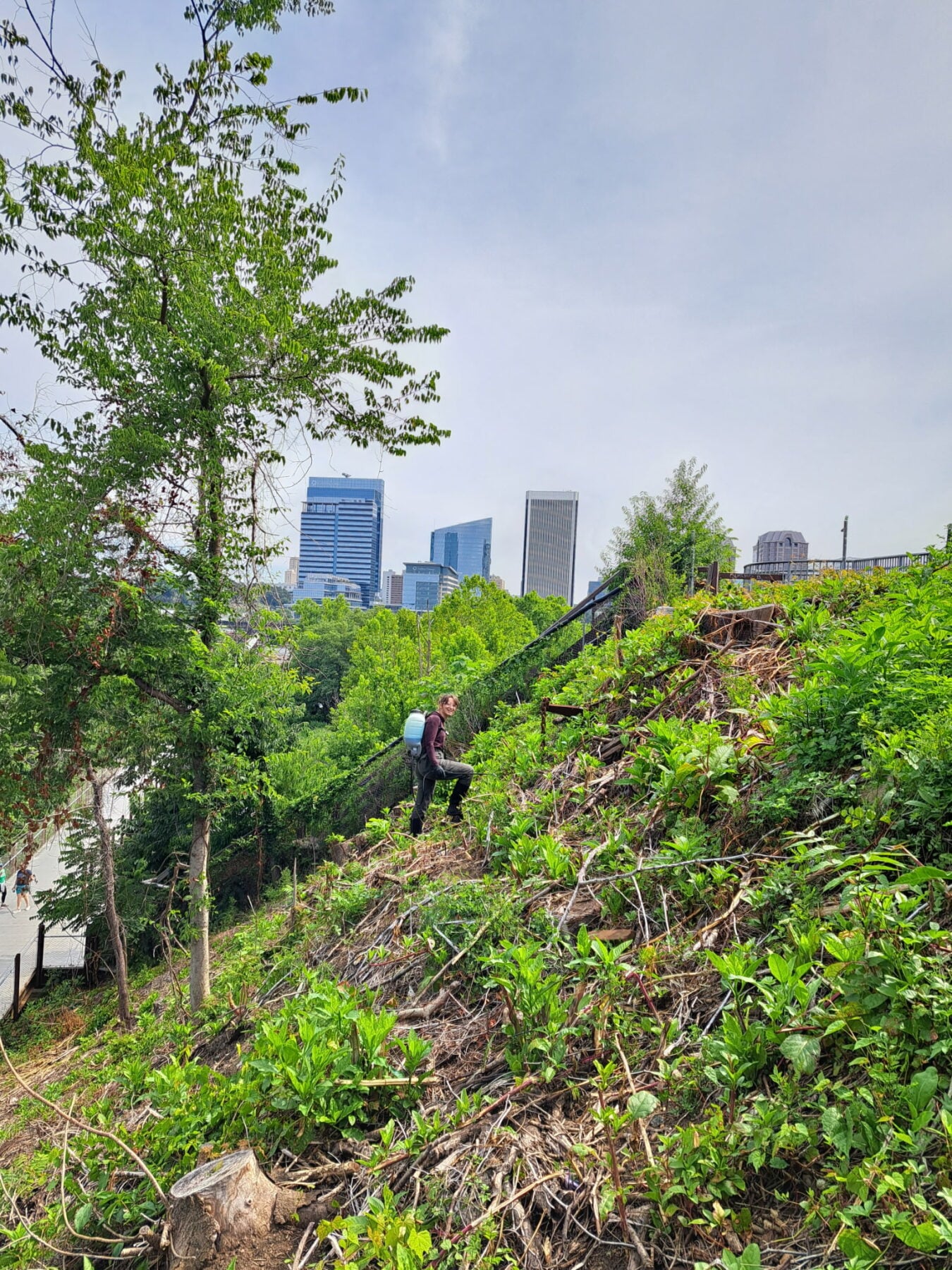 We’ve also run into an issue that we don’t always deal with in the Park, and that’s the fact that once we treat the invasive trees, we need to get them removed ASAP! Having such a dense stand of dead or dying trees bordered so closely by walking paths is a huge hazard to visitors, but getting them removed is costly. Because of this challenge, we will be working toward fully clearing parts of the hillside in chunks as the funding becomes available. Each cleared space will be followed by a season of cover crop to help reintroduce some nutrients into the soil and will then be seeded with our native seed mix.
So where are we right now?
You might have noticed crews from our friends at Commonwealth Tree Care out near the wall this spring. They are clearing out all of the old railroad debris, litter, and dead plant material from the first “chunk” of the hillside. This work will be extremely helpful in preparing the site for our cover crop planting.
Why would we plant a cover crop? There’s pokeweed on the hillside already, and that’s native!
Pokeweed (Phytolacca americana) is an excellent native species that thrives in heavily disturbed, sunny spaces. Unfortunately, pokeweed can be very competitive, often creating a dense monoculture that prevents other native species from growing. Part of this is because it’s allelopathic, which means that its roots produce a biotoxin that suppresses the growth of other plants. Because we plan to plant a variety of natives here, we need to give a diverse group of plants the opportunity to thrive..
In its place, we will plant a temporary cover crop. Cover crops are being used more and more both in the agriculture industry as well as in natural resource management. For our purposes, they’re useful for stabilizing and reintroducing more nutrients back into the soil after heavy degradation, like we have with this invasive species cover. Cover crops are usually annuals, so as long as they aren’t allowed to set seed, they won’t regrow after they’re cut.
Once our cover crop is done for the season, we will sow a native wildflower and grass seed mix over the space. This mix will be specially tailored to the space and will include species that grow quickly and have deep, fibrous root systems that will help further stabilize the soil.
Stay tuned for more updates as our work here progresses!